Idealize + Devalue + Discard
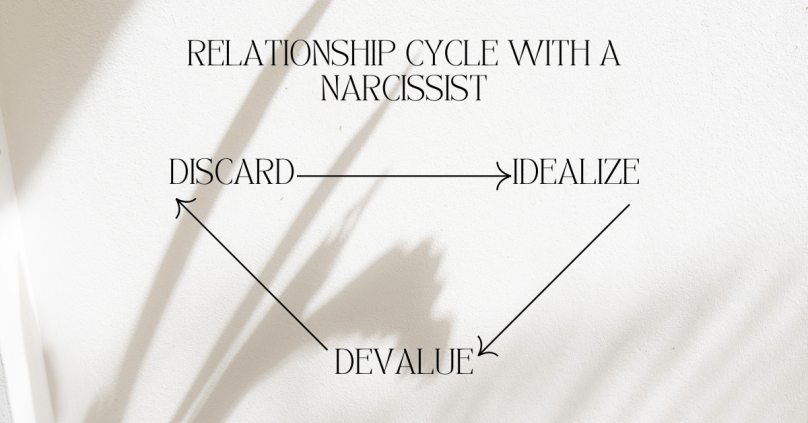
In my research and readings of narcissism, I learned there is a typical relationship cycle when dealing with a narcissist – idealize, devalue, and discard. This cycle is devastating to the narcissist’s partner and can quite literally destroy him or her on a mental and emotional level. It is also emotional and psychological abuse. Each phase includes a specific set behaviors which are all done in order to manipulate and extract narcissistic supply.
Idealize
The idealization phase is much like the “honeymoon” phase of any typical relationship. What sets this phase apart from a typical relationship is the level of intensity. In the beginning of a relationship with a narcissist, individuals may feel as if they have found their soulmate, often describing the love they have found as “otherworldly” – something they only could have imagined in their wildest dreams. The narcissist puts their partner on a pedestal, also referred to as “love bombing” – flooding you with compliments, “showing you off” to all their friends, wanting to spend excessive amounts of time together, and making promises of a future together. You will essentially feel like you are the most special person in their life. This phase can last from a few weeks to as much as a year. Then, the narcissist will begin chipping away at you – piece by piece.
Devalue
The “devalue” phase is exactly what it sounds like. Devaluing you, or throwing you off of the invisible pedestal they initially put you on. This typically begins happening when the relationship becomes comfortable and the narcissist begins to see that you are not “perfect”, that you are human and have flaws just like everyone else. It typically begins very slowly and covertly but builds with time – putting you down, gaslighting, withholding emotional or physical intimacy, disappearing from contact, projecting, and blaming you for anything that does not go his or her way. Again, this cycle typically begins very slowly and increases in frequency as the relationship continues. The narcissist will give his or her partner intermittent reinforcement throughout this phase which includes various “love bombing” behaviors from the idealization phase. The partner will often continue to stay in the relationship even as the frequency of devaluing behaviors increase for a few major reasons: 1.) the individual sees the “good” side of the narcissist, or the “potential” of a promising future, 2.) the narcissist has made the partner feel the need to “prove” his or her value and worthiness, and 3.) this cycle actually begins to rewire your brain – also known as “trauma bonding”.
Discard
The discard phase is when the narcissist ends the relationship. Typically, the discard will occur when the partner begins asking for compromise, reciprocity, honesty, and boundaries – all of which are reasonable and healthy relationship requests. When the relationship beings to require any effort on the narcissist’s end, he or she often decides the relationship has “expired”. Narcissists require excessive amounts of attention, whether that be positive or negative, to essentially “fill up” their ego tank. Relationship partners serve as a constant, stable source of supply. When the narcissist becomes bored of the main source of supply and can no longer get away with their negative behavior, that source of supply is no longer deemed “valuable”; therefore, the narcissist discards the relationship partner. The discard often occurs unexpectedly in an egregious form of emotional abuse. The partner is left appalled and bewildered, unable to understand how someone who he or she loved so much could throw their entire relationship away.
Once the discard has taken place, the narcissist may begin to “hoover” to maintain his or her narcissistic supply. This generally happens when the partner decides to end the relationship before the narcissist has the chance to discard; however, hoovering can occur months, even years, after the initial discard regardless of who initiated the discard. Sometimes, the discard happens in a way that leaves “hope” for the relationship in the eyes of the partner, which can essentially extend the discard phase much longer, leading to an even more malicious final discard.
The discard often includes triangulation with a new partner. The narcissist will be on the hunt for a new source of primary supply long before the relationship ends. Often, narcissists will be involved (talking to and/or physically engaging) with other women or men throughout the relationship, as this feeds their ego and serves as another source of supply. Sometimes, they may use one of these individuals as a main source of supply after the discard. Other times, they will begin hunting for a new primary supply once the current partner begins requesting effort, despite having other sources of secondary supply. After the discard, this new supply will become their main source; thus, “triangulating” the old partner.
When the old partner sees the narcissist with a new partner shortly after the discard, it causes an even greater sense of emotional turmoil. The old partner is left believing all the negative statements that the narcissist previously said or implied – you’re too sensitive, you’re a miserable person to be around, you have major character flaws, you always start an argument, you are exhausting to be with – how else could he or she have moved on so quickly? The previous partner will often ruminate on these overly harsh criticisms and may even begin to believe they are worthless and unlovable. This is extremely damaging and emotionally traumatic for the old partner, often leaving them depressed and full of anxiety. In the worst cases, victims will begin having suicidal thoughts or committing suicide because they feel so worthless and unlovable as a result of the abuse.
Final Comments
This type of relationship cycle is torturous. Many people who have not experienced this type of abuse would say physical abuse is “worse” but just because the damage is not visible does not mean it isn’t equally painful. Some may argue that you should have left sooner or tell you that you’re “stupid” for getting back together with your abuser. Yet, when you’re in the situation, it is extremely difficult to end the relationship and cut all forms of contact. You may be thinking well, why is it so hard when you’re being treated badly? The trauma bond formed early on in the relationship alters brain chemistry to function similarly to that of an addict. You being to crave those emotional “highs”, so you push through those “lows” to get that next “hit”. Of course there are other contributing factors, but I believe this one has the greatest impact.
If you feel you are experiencing emotional abuse, I recommend seeking therapy immediately. Do your research and find a therapist, psychologist, or counselor who is trained in emotional abuse recovery. If not properly trained and unaware of the patterns and characteristics of emotional abuse, he or she may do more harm than good.

 Main + Meg