What is self-care?
Self-care is defined as the practice of taking action to preserve one’s own health. It is not synonymous with self-indulgence or selfishness. Self-care means taking care of yourself so you can do your job, you can help others, you can be healthy, and you can do all the things you need and want to accomplish in a day. It promotes healthy functioning and enhances your overall well-being. It’s just like when a flight attendant reviews the procedure of using oxygen masks in case of emergency. You’re instructed to put your mask on first before helping others because you won’t be able to help others if you aren’t able to breathe. The same principle applies to self-care. You must take care of yourself first so that you can be at your best self to help others.
You can’t pour from an empty cup. Fill your cup first.
Joseph Fleming
Additionally, you must take care of yourself for your health and well-being. Your needs are equally important to those around you and you owe it to yourself to take care of YOU so you can feel good about yourself!
Self-care will look different and mean something different to everyone. However, at the end of the day, it’s about doing anything that feels nourishing to you.
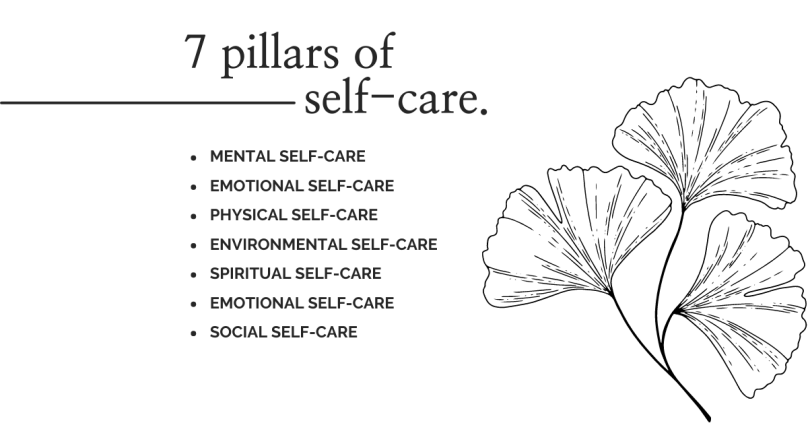
There are 7 pillars of self-care:
- Mental
- Emotional
- Physical
- Environmental
- Spiritual
- Recreational
- Social
We want to maintain somewhat of a balance among these pillars. This list may be overwhelming but you don’t have to tackle them all at once. You can choose one area to focus on for a few weeks then add another area as you go. The goal is about finding a balance that works for you. For example, some people don’t need as much social interaction as others. You may feel balanced by spending time with your friends once or twice a month; whereas, someone else may need more social interaction, like once or twice per week. It’s okay if your idea of self-care looks totally different than someone else’s. The most important thing is staying mindful and paying attention to which areas are in need of attention so all areas don’t begin to collapse.
Let’s talk about each pillar:
Mental Self-Care
Mental Self-Care, or intellectual self-care, is about cultivating and attending to a healthy mindset. This one is important so you can develop a healthy mindset and continue to grow your skills, learn new skills, and enhance knowledge.
Ideas:
- Reading a book
- Writing in a journal
- Meditation + mindfulness
- Writing a to-do list or brain dump
- Taking a break from social media and the internet
- Continuing education courses in your field of expertise
- Trying a new activity to engage your brain in a new way
Emotional Self-Care
Emotional Self-Care is about learning healthy coping strategies and implementing them when emotional matters occur. It’s also about figuring yourself out so you can understand yourself better and develop healthy emotional responses. Self-compassion is important to practice as well.
Ideas:
- Setting boundaries
- Positive affirmations
- Making a gratitude list
- Asking for help if you need it
- Listening to your favorite songs
Physical Self-Care
Physical Self-Care seems a little obvious: exercising, eating nutritious meals, and basic hygiene. What many people don’t know is it is also about sleeping well and keeping up with doctor’s appointments. It can also include health literacy. For example, reading up on a diagnosis and learning ways to minimize issues with the diagnosis.
Ideas:
- Going for a walk
- Drinking more water
- Eating at regular times
- Sleeping 7-8 hours each night
- Taking medication and vitamins
- Exercising – I’ve been using ClassPass to try different workouts lately (highly recommend)
Environmental Self-Care
Environmental Self-Care is simply taking care of the spaces around you. For example, keeping a clean house or decluttering your pantry or closet. It can also include exploring a new place in your community.
Ideas:
- Clean out your closet
- Organizing your work space
- Establish a basic cleaning routine
- Explore a place you’ve been wanting to go
- Appeal to your 5 senses – put on your favorite music, light a candle, sip on warm tea or cold water with lemon, adjust the lighting, and slip into a comfy outfit (great daily wind-down routine)
Spiritual Self-Care
Spiritual Self-Care is about taking care of your soul – finding activities that give you a sense of purpose and add meaning to your life. It doesn’t have to include religion if that’s not something your into.
Ideas:
- Meditation
- Identifying your values
- Prayer or connecting to a higher power
- Spending time in nature or with animals
- Volunteering for a cause meaningful to you
Recreational Self-Care
Recreational Self-Care is about connecting with your inner child by doing something fun and trying new experiences. This allows you to disconnect from the daily routine of life and all the things on your to-do list.
Ideas:
- Playing a game
- Recreational sports
- Doing absolutely nothing
- Any hobby or activity that brings you joy
- Going on an adventure or exploring a new place
- Anything that will switch up your daily routine allowing for “fun” time
Social Self-Care
Social Self-Care doesn’t sound like a typical part of “self-care”, but it is important to spend time connecting with others. This brings a sense of belonging and acceptance.
Ideas:
- Visiting a friend
- FaceTime or call a loved one you don’t see often
- Joining a club – volunteer groups, recreational sports, etc.
- Finding a community or support group to get involved with
- Spending time with friends, family, or anyone you enjoy being around
Benefits of Self-Care
There are so many benefits of self-care practices – from reducing anxiety, depression, burnout, and stress to increasing energy and overall happiness. Not to mention, research has shown long-term effects of self-care practices are invaluable. Click here and here for a couple articles outlining all the major benefits.
The National Institute of Mental Health also has a wonderful article regarding self-care linked here.
Additionally, I found two other great articles for your reference on Psychcom and Psychology Today linked here and here.
How to Build Your Own Customized Self-Care Routine
When I was beginning to really focus on my personal self-care routine, I used the article here to guide me. I found the steps outlined to be incredibly helpful. I have listed them below for your reference.
- Assess your needs – make a list of all the major categories in your life such as school or work, family, friends, pets, and physical health.
- Consider your stressors – determine which areas of your life contribute to stress and think about or research ways to manage that stress.
- Devise self-care strategies – consider activities that can help you feel better in each area. For example, if you struggle remembering to drink enough water throughout the day, set a reminder on your phone that will persist on your Home Screen throughout the day.
- Plan for challenges – there will always be challenges. If you notice one area is being neglected, create a new plan of action.
- Take small steps – trying to tackle everything all at once will more than likely be overwhelming. Choose one area to focus on improving for a month. Set goals. Then, add another area the next month.
- Schedule time to focus on your needs – add self-care time into your planner and keep track of your progress towards each goal.
A Look at My Self-Care Plan:
At the beginning of the year, I sat down and determined my “focus” for the year. I made boundaries, discipline, and self-care my top priorities. Then, I listed each major area of my life. Within these areas, I listed 3-5 goals to focus on. Some of these goals were already in progress, but I know I have a tendency to slack off as life gets busy so I kept them on my list to track maintenance. Take a look out my outline below:
- PROFESSIONAL
- PERSONAL
- SPIRITUAL
- RELATIONSHIPS
- FINANCIAL
I did not include my personal goals in each area because well, they’re personal – but I chose to focus on professional and personal goals first. I chose one or two goals from each area that were of utmost importance to me to improve and I focused on those for the month of January. In February and March, I incorporated two more goals goal from both categories. I still track my progress in the other areas and use that to choose my focus for the next month. So far, this is helping a ton in terms of creating stronger boundaries with others and myself, re-cultivating discipline back into my life, and taking care of myself and well-being through self-care practices.
This can seem daunting at first – it was for me. However, I will say I have maintained this system for the first 3 months of the year and I feel much better overall. I also included little ways to celebrate when I reach a goal. This gives me something additional to look forward to. It took a little trial-and-error, but I found what works for me. I highly recommend giving this a try if you’re looking to improve your self-care practices!
If you would like some other suggestions or want to share your own personal suggestions, leave a comment below!

 Main + Meg