Cognitive Distortions

Cognitive Distortions || What They Are + How To Keep Them At Bay

What are cognitive distortions?

Cognitive distortions are negative thinking patterns that are not based in fact and do not reflect reality. These patterns create an unrealistic – and usually negative – perception leading you to have negatively biased feelings about situations and events. Cognitive distortions are not a mental illness. In fact, it is completely normal to have the occasional cognitive distortion. However, if these thinking patterns are reinforced over time, then it can increase mental health issues including, but not limited to, anxiety and depression.

Luckily, you can change your thinking patterns to improve your mental well-being! Before we talk about how to change these patterns, let’s dive into some of the most common cognitive distortions. For the sake of being thorough, I have included examples on both the negative and positive ends of the spectrum.

The Twelve Most Common Cognitive Distortions

  • All-or-Nothing Thinking
  • Overgeneralization
  • Mental Filter
  • Discounting The Facts – Positive + Negative
  • Jumping to Conclusions – Mind-Reading + Fortune-Telling
  • Magnification + Minimization
  • Emotional Reasoning
  • “Should” Statements
  • Labeling
  • Blame
  • Personalization
  • Catastrophic Thinking

All-Or-Nothing Thinking

All-or-nothing thinking is when a person habitually thinks in extremes without considering all the facts of the situation. This is also called “black-and-white” thinking – shades of grey do not exist.

For example: When you fail, you may tell yourself you are a total failure. Or when you succeed, you tell yourself that you’re a winner and you’re the best there is.

Overgeneralizing

Overgeneralizing is when a person reaches a conclusion about one event and applies that conclusion to all subsequent events – thinking one negative (or positive) event will be a never-ending series of negative (or positive) events.

For example: When you are rejected by someone you like, you tell yourself you are unlovable and will be alone forever. Or when you overcome a negative event and things are going well again, you may tell yourself that all problems are solved, you will never face another problem again, and will be happy forevermore.

Mental Filtering

Mental filtering is when a person ignores all positives and only focuses on the negatives, or vice versa.

For example: When you go to work with a new haircut, you might have 10 people comment and tell you how great your new style looks. But the 11th person asks you why you changed your style or says he//she liked your hair better before, so you focus on the one negative comment and wear a hat to work until it grows back. Or when you go out to dinner with a friend, you tell yourself you will feel so much better after having a drink, completely ignoring the fact you typically drink too much and end up with a hangover the next day.

Discounting The facts

Discounting the facts is very similar to mental filtering. The difference is that instead of dismissing or ignoring the positives or negatives as a person with a mental filter would, you explain the positives or negatives away as if they “don’t count” to maintain universally negative or positive thoughts.

For example – discounting the positive: When a person gives you a genuine compliment, you tell yourself they are only saying that to make you feel good. Or – discounting the negative: When you get into an argument with someone, you become defensive and insist the other person is wrong dismissing their concern completely without seeing their perspective regarding the situation at hand.

Jumping to Conclusions

Jumping to conclusions is when you reach a conclusion that is not supported by the facts. There are two common forms: Mind-Reading and Fortune-Telling.

Mind-Reading

Mind-reading is when you assume you know how others are thinking or feeling. Try to avoid getting this confused with empathy – the ability to perceive or understand what someone may be feeling. If you need help distinguishing between the two, consider all of the facts of the situation. Avoid focusing on the facts that would only confirm your suspicions.

For example: When you’re at a party and you don’t know many people there, you start to feel shy and withdrawn, telling yourself others would look down on you if they knew you felt shy. Or when you’re in a relationship with someone, you tell yourself that everything is going great while the other person is actually frustrated or unhappy with you.

FORTUNE-TELLing

Fortune-telling is when a person predicts the way a future event will take place.

For example: When you are depressed, you may tell yourself you will never feel better and will never be happy again. Or when you go out to dinner, you may tell yourself you will just have one drink and everything will be fine, while you know you have never stopped after one drink in the past and more often than not, things do not turn out fine.

magnification + minimization

Magnification and minimization occurs when you either blow things out of proportion or significantly reduce their importance.

For example – magnification: When you are procrastinating, you think of everything you need to do and tell yourself how daunting each task will be. Or when you’re trying to eat healthier, you see the ice cream in your freezer and tell yourself how delicious it will be.

For example – minimization: When you’re procrastinating, you tell yourself that your efforts today won’t make any difference tomorrow so you might as well wait another day. Or when you see the ice cream in your freezer, you debate whether or not it will actually be good enough to give in to the urge.

Emotional Reasoning

Emotional reasoning is when you reason from your feelings versus the facts. In reality, your feelings are a direct result of your thoughts and not from what is actually happening. If your thoughts are distorted, then your feelings will be misleading as well.

For example: When you procrastinate, you tell yourself “I’ll complete my report when I’m in a better mood – I just don’t feel like it right now.” The time never comes and you miss the deadline so you tell yourself, “I feel useless so I must be useless.” Or when you meet someone really attractive, you may feel so happy and excited that you think he or she must be the person of your dreams.

Emotional reasoning is tricky because it is important to validate your emotions about a situation or event. However, when it comes to judging your reality, you must stay focused and rooted in the actual evidence.

“Should” Statements

“Should” statements can be self-directed, other-directed, or world-directed. These statements occur when a person believes something “should have” happened a certain way or that the person (or someone else) “should have” done something that they didn’t or are unable to do.

For example – self-directed: When you make a mistake, you tell yourself “you shouldn’t have made such a stupid mistake.” Or when you’ve had a tough day, you tell yourself “I’ve had a stressful day and I should have a drink.” – all the while, knowing that is not the best choice for you to make.

Labeling

Labeling is when you label yourself or someone else in a particular way after an event. It is an extreme form of overgeneralization.

For example: When you’re not getting along with someone, you label them as an incompetent loser. Or when you do well, you may tell yourself you are special and a winner. As a side note, this is often used as a motivational strategy by coaches and motivational speakers – but in reality, no one wins or loses all the time.

BLAME

Blaming occurs when you find fault with yourself (self-blame) or others (other-blame).

For example – self-blame: When you’re depressed, you may beat yourself up over all of your mistakes and shortcomings instead of using your energy to come up with solutions to your problems. Or – other-blame: When you have a conflict with someone, you tell yourself the other person is to blame for everything and that you are the victim and completely overlook your own role in the issue.

Personalization

Personalization is when you take things personally, but in reality, they are not connected to you in any way at all.

For example: When you get a note from your child’s teacher at school stating he or she isn’t doing well, you blame yourself for not being a good mother. Or when you see one of your friends has posted a story on a social media platform and he or she is out without you, you assume he or she doesn’t really like you and intentionally left you out.

Catastrophic Thinking

Catastrophic thinking occurs when a person assumes the worst in a situation where the outcome is unknown and there is lack of evidence to support his or her prediction. When people engage in catastrophic thinking, a typical worry can escalate and create an unnecessary amount of anxiety.

For example: When you call your mom, she doesn’t answer. You try calling again – no answer. You try again and still no response. Then, you begin to think she has been in a tragic accident and you will never see her again. When in reality, she was taking a nap and her phone was on silent.

It is important to note this doesn’t mean a person is “overreacting” – people who have experienced repeated and//or ongoing traumatic events are more likely to fear the worst outcome in many circumstances.

Challenging Cognitive Distortions

Now that we know the most common cognitive distortions, let’s discuss how we can change these thought patterns when they pop up.

  • Identify the thought
  • Reframe the thought
  • Perform a cost-benefit analysis
  • Perform a behavior-chain analysis
  • Consider why you may feel and think this way
  • Consider therapy // Cognitive Behavioral Therapy

Identify the thought

When you notice yourself engaging in negative thinking, take a few minutes to analyze your thought process that led to your conclusion. Is there evidence supporting this thought? Is this conclusion rooted in feelings or facts? Do you have biases that would influence this thinking?

Reframe the thought

“Try on a different pair of lenses” and approach the situation from a different perspective. Look for alternative explanations, objective evidence, and positive considerations. It might be helpful to write down your initial thought along with several other alternatives.

Perform a cost-benefit analysis

More often than not, people will repeat behaviors and patterns that will deliver a benefit to some degree. Ask yourself tough questions. For example, how have these thought patterns helped me cope in the past? Do I gain a sense of control by engaging in these thoughts when I would otherwise feel powerless? Do these thoughts allow me to avoid taking a risk? Or do they allow me to escape accountability?

You can also start by weighing out the pros and cons of your thought processes – what do you gain and what do you lose by these thoughts?

Perform a behavior-chain analysis

A behavior-chain analysis is a 5-step process allowing you to identify what contributed to your thoughts. Here is a basic outline:

  1. What are you feeling?
  2. What events led up to this?
  3. What vulnerability factors could be contributing to this? Lack of food? Lack of sleep? Substance misuse or abuse?
  4. What thoughts are you thinking? Write them down and see if you notice any cognitive distortions.
  5. Use logical solutions to navigate through your thoughts to transform them into a more positive way of looking at the situation.

Consider why you may think or feel this way

Think about the conclusion you made and how you got to that point. Determine if any preconceptions may have influenced how you came to this conclusion.

Consider Therapy // Cognitive Behavioral Therapy (CBT)

CBT is a form of talk therapy that teaches you to identify, interrupt, and change unhelpful and unhealthy thinking patterns.

If you’re looking for a therapist, you can go to psychologytoday.com to search for a local therapist who is properly trained and accepts your insurance.

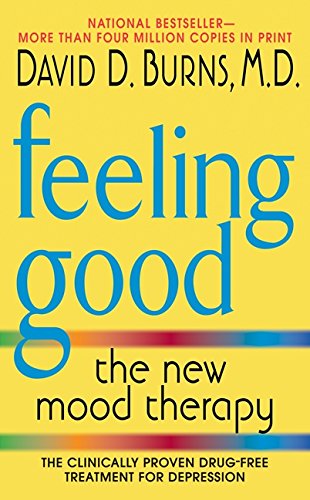
If you aren’t interested in talking with a therapist, I highly recommend reading the book Feeling Good: The New Mood Therapy by Dr. David Burns. I have read this book cover to cover and it truly changed my life for the better. If someone ever asks me for advice, I recommend this book every single time!

If you have any other helpful tips or suggestions, leave a comment!

xo, Meg signature

Never Miss A Post + Subscribe Below!

7 Pillars Of Self Care

Self-Care || What It Is + How To Build Your Own Self-Care Routine

What is self-care?

Self-care is defined as the practice of taking action to preserve one’s own health. It is not synonymous with self-indulgence or selfishness. Self-care means taking care of yourself so you can do your job, you can help others, you can be healthy, and you can do all the things you need and want to accomplish in a day. It promotes healthy functioning and enhances your overall well-being. It’s just like when a flight attendant reviews the procedure of using oxygen masks in case of emergency. You’re instructed to put your mask on first before helping others because you won’t be able to help others if you aren’t able to breathe. The same principle applies to self-care. You must take care of yourself first so that you can be at your best self to help others.

You can’t pour from an empty cup. Fill your cup first.

Joseph Fleming

Additionally, you must take care of yourself for your health and well-being. Your needs are equally important to those around you and you owe it to yourself to take care of YOU so you can feel good about yourself!

Self-care will look different and mean something different to everyone. However, at the end of the day, it’s about doing anything that feels nourishing to you.

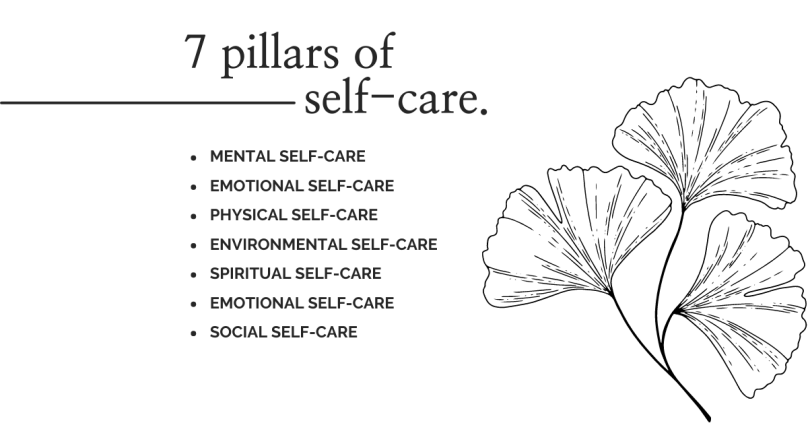
There are 7 pillars of self-care:

  1. Mental
  2. Emotional
  3. Physical
  4. Environmental
  5. Spiritual
  6. Recreational
  7. Social

We want to maintain somewhat of a balance among these pillars. This list may be overwhelming but you don’t have to tackle them all at once. You can choose one area to focus on for a few weeks then add another area as you go. The goal is about finding a balance that works for you. For example, some people don’t need as much social interaction as others. You may feel balanced by spending time with your friends once or twice a month; whereas, someone else may need more social interaction, like once or twice per week. It’s okay if your idea of self-care looks totally different than someone else’s. The most important thing is staying mindful and paying attention to which areas are in need of attention so all areas don’t begin to collapse.

Let’s talk about each pillar:

Mental Self-Care

Mental Self-Care, or intellectual self-care, is about cultivating and attending to a healthy mindset. This one is important so you can develop a healthy mindset and continue to grow your skills, learn new skills, and enhance knowledge.

Ideas:

  • Reading a book
  • Writing in a journal
  • Meditation + mindfulness
  • Writing a to-do list or brain dump
  • Taking a break from social media and the internet
  • Continuing education courses in your field of expertise
  • Trying a new activity to engage your brain in a new way

Emotional Self-Care

Emotional Self-Care is about learning healthy coping strategies and implementing them when emotional matters occur. It’s also about figuring yourself out so you can understand yourself better and develop healthy emotional responses. Self-compassion is important to practice as well.

Ideas:

  • Setting boundaries
  • Positive affirmations
  • Making a gratitude list
  • Asking for help if you need it
  • Listening to your favorite songs

Physical Self-Care

Physical Self-Care seems a little obvious: exercising, eating nutritious meals, and basic hygiene. What many people don’t know is it is also about sleeping well and keeping up with doctor’s appointments. It can also include health literacy. For example, reading up on a diagnosis and learning ways to minimize issues with the diagnosis.

Ideas:

  • Going for a walk
  • Drinking more water
  • Eating at regular times
  • Sleeping 7-8 hours each night
  • Taking medication and vitamins
  • Exercising – I’ve been using ClassPass to try different workouts lately (highly recommend)

Environmental Self-Care

Environmental Self-Care is simply taking care of the spaces around you. For example, keeping a clean house or decluttering your pantry or closet. It can also include exploring a new place in your community.

Ideas:

  • Clean out your closet
  • Organizing your work space
  • Establish a basic cleaning routine
  • Explore a place you’ve been wanting to go
  • Appeal to your 5 senses – put on your favorite music, light a candle, sip on warm tea or cold water with lemon, adjust the lighting, and slip into a comfy outfit (great daily wind-down routine)

Spiritual Self-Care

Spiritual Self-Care is about taking care of your soul – finding activities that give you a sense of purpose and add meaning to your life. It doesn’t have to include religion if that’s not something your into.

Ideas:

  • Meditation
  • Identifying your values
  • Prayer or connecting to a higher power
  • Spending time in nature or with animals
  • Volunteering for a cause meaningful to you

Recreational Self-Care

Recreational Self-Care is about connecting with your inner child by doing something fun and trying new experiences. This allows you to disconnect from the daily routine of life and all the things on your to-do list.

Ideas:

  • Playing a game
  • Recreational sports
  • Doing absolutely nothing
  • Any hobby or activity that brings you joy
  • Going on an adventure or exploring a new place
  • Anything that will switch up your daily routine allowing for “fun” time

Social Self-Care

Social Self-Care doesn’t sound like a typical part of “self-care”, but it is important to spend time connecting with others. This brings a sense of belonging and acceptance.

Ideas:

  • Visiting a friend
  • FaceTime or call a loved one you don’t see often
  • Joining a club – volunteer groups, recreational sports, etc.
  • Finding a community or support group to get involved with
  • Spending time with friends, family, or anyone you enjoy being around

Benefits of Self-Care

There are so many benefits of self-care practices – from reducing anxiety, depression, burnout, and stress to increasing energy and overall happiness. Not to mention, research has shown long-term effects of self-care practices are invaluable. Click here and here for a couple articles outlining all the major benefits.

The National Institute of Mental Health also has a wonderful article regarding self-care linked here.

Additionally, I found two other great articles for your reference on Psychcom and Psychology Today linked here and here.

How to Build Your Own Customized Self-Care Routine

When I was beginning to really focus on my personal self-care routine, I used the article here to guide me. I found the steps outlined to be incredibly helpful. I have listed them below for your reference.

  • Assess your needs – make a list of all the major categories in your life such as school or work, family, friends, pets, and physical health.
  • Consider your stressors – determine which areas of your life contribute to stress and think about or research ways to manage that stress.
  • Devise self-care strategies – consider activities that can help you feel better in each area. For example, if you struggle remembering to drink enough water throughout the day, set a reminder on your phone that will persist on your Home Screen throughout the day.
  • Plan for challenges – there will always be challenges. If you notice one area is being neglected, create a new plan of action.
  • Take small steps – trying to tackle everything all at once will more than likely be overwhelming. Choose one area to focus on improving for a month. Set goals. Then, add another area the next month.
  • Schedule time to focus on your needs – add self-care time into your planner and keep track of your progress towards each goal.

A Look at My Self-Care Plan:

At the beginning of the year, I sat down and determined my “focus” for the year. I made boundaries, discipline, and self-care my top priorities. Then, I listed each major area of my life. Within these areas, I listed 3-5 goals to focus on. Some of these goals were already in progress, but I know I have a tendency to slack off as life gets busy so I kept them on my list to track maintenance. Take a look out my outline below:

  • PROFESSIONAL
  • PERSONAL
  • SPIRITUAL
  • RELATIONSHIPS
  • FINANCIAL

I did not include my personal goals in each area because well, they’re personal – but I chose to focus on professional and personal goals first. I chose one or two goals from each area that were of utmost importance to me to improve and I focused on those for the month of January. In February and March, I incorporated two more goals goal from both categories. I still track my progress in the other areas and use that to choose my focus for the next month. So far, this is helping a ton in terms of creating stronger boundaries with others and myself, re-cultivating discipline back into my life, and taking care of myself and well-being through self-care practices.

This can seem daunting at first – it was for me. However, I will say I have maintained this system for the first 3 months of the year and I feel much better overall. I also included little ways to celebrate when I reach a goal. This gives me something additional to look forward to. It took a little trial-and-error, but I found what works for me. I highly recommend giving this a try if you’re looking to improve your self-care practices!

If you would like some other suggestions or want to share your own personal suggestions, leave a comment below!

xo, Meg signature
Selfhealers Soundboard

SelfHealers SoundBoard

+ How To Do The Work by Dr. Nicole LePera

Selfhealers Soundboard
How To Do The Work

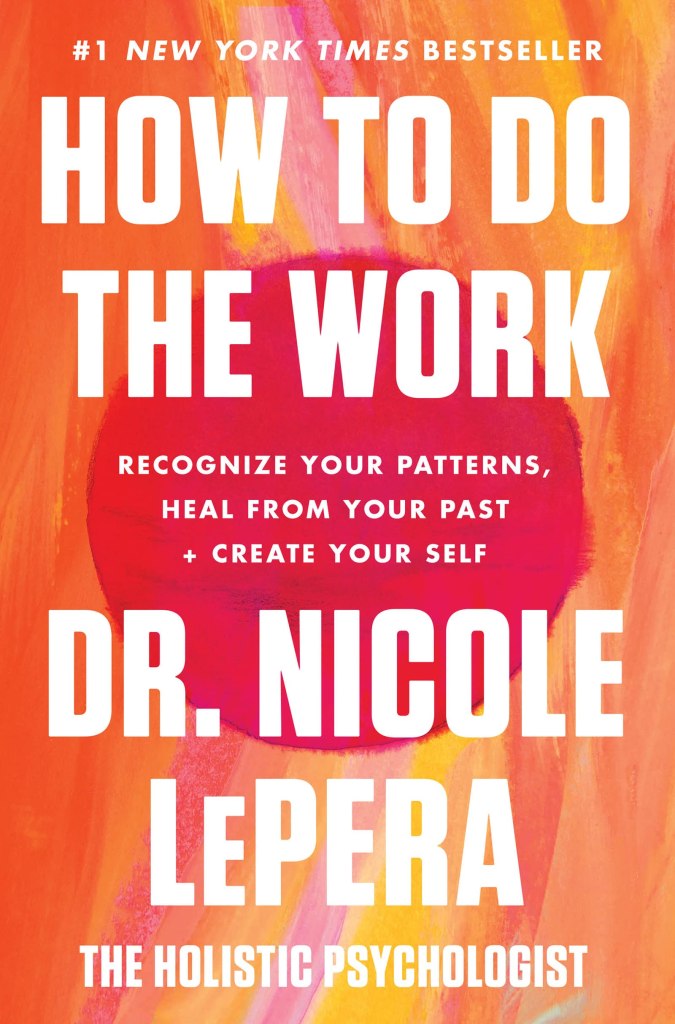
Currently, I’ve been listening to the SelfHealers SoundBoard podcast. Dr. Nicole LePera dives into her book How To Do The Work, released in March 2021. I just completed this podcast series and wow, just WOW!!! It was incredibly insightful and really helped me identify and understand my core triggers – wayyy back from childhood. I’m really looking forward to listening to her other podcast episodes unrelated to the book series.

Dr. LePera takes a holistic approach versus traditional psychotherapy. Her method unites mental, physical, and spiritual wellness to create an interdisciplinary approach to healing. Personally, I have found her work more helpful to my personal experiences than others. Not to say other readings + podcasts haven’t been helpful, but her approach has definitely been the most useful overall for me.

I had her book on my Amazon wishlist for awhile and finally bought it. I haven’t began reading yet but will keep you all updated once I get started. Her new book, How To Meet Yourself, will be released December 6th.

Links to her podcast, book, website, + instagram are linked below!

Hope you all find these resources as helpful as I have!

xo, Meg signature
Must Reads || Mental Health

Must Reads

For mental health + self care

I have put together a list of my must reads for anyone interested in improving their mental health. I will continue adding to this list so make sure to check back all along!

All are linked to my Amazon storefront here!

xo, Meg signature
Compassion For The Narcissist

Compassion For The Narcissist

Should I have compassion for a narcissist?

First and foremost, narcissism exists on a spectrum. We all display narcissistic traits from time to time. This is completely normal. However, there are some individuals who are higher on the spectrum and/or have Narcissistic Personality Disorder (NPD). In order to be diagnosed with the personality disorder, you must meet the criteria listed in the DSM-5. It is also important to mention just because a narcissistic individual is not diagnosed with NPD does not mean their personal narcissistic traits can’t be equally harmful as a person with diagnosed NPD. Narcissists often have a history of neglect or abuse in childhood or some other traumatic childhood experience. Knowing this, you may naturally have empathy and compassion for a narcissistic individual.

To have compassion for a narcissist:

I am no psychologist or therapist, but when I put my mind in a therapist’s perspective, I certainly believe in having compassion for the narcissist. Their behavior is rooted from painful experiences which should never be ignored or invalidated. I can empathize with their painful experiences and understand why this behavior presents – likely as a protective mechanism. They have wounds they perpetually try to compensate for throughout their lives.

Unfortunately, there is a problem with this approach. More than likely, the narcissist doesn’t think they have a problem to begin with. When you attempt to address their behavior, he/she will likely take your empathy, care, and genuine concern as criticism and judgement. You, then, become their enemy. They have spent their lives trying to conceal their wound and their pain. Therefore, when you attempt to empathize with them, they will view this as a weakness.

In addition, narcissists typically view empathetic people as individuals they can easily use and manipulate. You may think you’re doing the right thing by being a supportive, caring person in their life; however, you are being drawn into their game of chaos and confusion. Narcissists require others to fulfill their needs or extract “narcissistic supply” from. They will use you as someone to bully, to manipulate, to make them feel good about themselves, to support them all while they emotionally abuse someone else, etc. Essentially, everyone in their life is a “pawn” they can use for whatever reason they deem necessary at the time. There is no real, true relationship with a narcissist.

To not have compassion for a narcissist:

Knowing narcissists are users, abusers, and manipulators makes it easy to have no compassion for them whatsoever. It may make you despise the narcissistic individual. This is also problematic – you are now holding on to anger towards the narcissist. You forget that they have wounds that led to their behavior in the first place. It does you no good to hate them – you can’t change them or make them want to change. Moreover, it is not productive to hold on to the negative feeling you have about them due to their behavior. All that will do is hurt you.

To remain neutral:

You can have compassion for a narcissist while maintaining your mental health and not getting involved in their drama and chaos. How? By protecting your boundaries and keeping the realistic perspective of narcissism in mind.

Remain neutral by understanding there is likely (but not always) a childhood trauma causing them deep pain which, in turn, causes their negative behavior to occur. Protect your boundaries by not engaging in possible manipulative tactics. Avoid giving them “narcissistic supply”, especially when it is unwarranted. Remember narcissists use a variety of methods to manipulate others and know they are very skilled in this category. There is often a deeper motive you may be completely unaware of so proceed with caution.

Lastly, most narcissistic individuals do not believe they have a problem, as previously mentioned. However, if a narcissist reaches a point where they are acknowledging how they hurt others and are actively trying to improve and change for the better, then they certainly deserve compassion and support. My advice is to make sure they’re truly making an effort before giving them the benefit of the doubt and being an all-in supporter. Don’t allow them to exploit you further by saying they want to “be better” but doing nothing to actually become better.

See the link here for further information.

Take Care Signature
Reactive Abuse Vs. Mutual Abuse

Reactive Abuse Vs. Mutual Abuse

What is reactive abuse?

In a nutshell, reactive abuse is when a victim reacts abusively in response to an abusive experience. This is typically what the abuser wants – this way, they can “prove” how unstable or mentally ill you are. It can even be used for future manipulation. They can essentially hold your reaction against you in an attempt to gain your compliance or hold guilt over your head when you confront them about their abusive behavior in the future.

What is mutual abuse?

Mutual abuse is when both partners are equally abusive in the relationship. Experts say mutual abuse is extremely rare and many do not believe it exists at all due to the power and control dynamic of abusive relationships. Typically, only one partner is seeking power and control, while the other is seeking out a normal, healthy relationship.

What to do:

When you notice you are behaving a certain way, you may start to think “why am I behaving like this?” or “this is not the norm for me, what is going on?”. This is a key indicator that something is not right with your relationship. Try not to allow yourself to go down the rabbit hole of “this is all my fault”. Instead, take a step back and make note of your patterns. Ask yourself when your behavior occurs and consider what led up to said behavior. Are you being the instigator and provoking your partner? Or are you reacting to their abusive behavior?

I encourage you to avoid looking at the situation as “mutual abuse”. At first glance or first thought, it may very well seem like you both are mutually abusive. However, abusive relationships typically do not occur in this manner. Even experts are uncertain if “mutual abuse” exists at all. Why? Because abuse is an imbalance of power. One partner is seeking control of the other whether that be through physical, emotional, verbal, sexual, or psychological abuse.

Instead, focus on YOUR behavior. Note whether or not you are reacting to your partner being abusive initially. Think about what led up to your behavior and consider other more positive ways to handle similar situations in the future. Then, prepare ahead to respond versus react in these situations.

Learning to respond versus react is imperative. The abuser relies on your reaction and he or she will use your reactions against you time and time again. Most abusers will either say you are the abusive one or that you both are mutually abusive so that they don’t have to take responsibility for their own actions. In order to take your power back, you must learn to respond and avoid reacting. If your partner’s behavior continues despite your positive changes, then it is likely he or she is intentionally provoking you. At this point, it may be in your better interest to consider exiting the relationship.

Remember, reacting to an abusive situation does not mean your behavior is acceptable to continue engaging in moving forward. However, knowing you are reacting versus instigating is essential in healing and growing from the situation, especially when/if your partner holds your reaction against you in the future.

See the link here for more information.

Take Care Signature
Trauma Definition

Defining Trauma

What is Trauma?

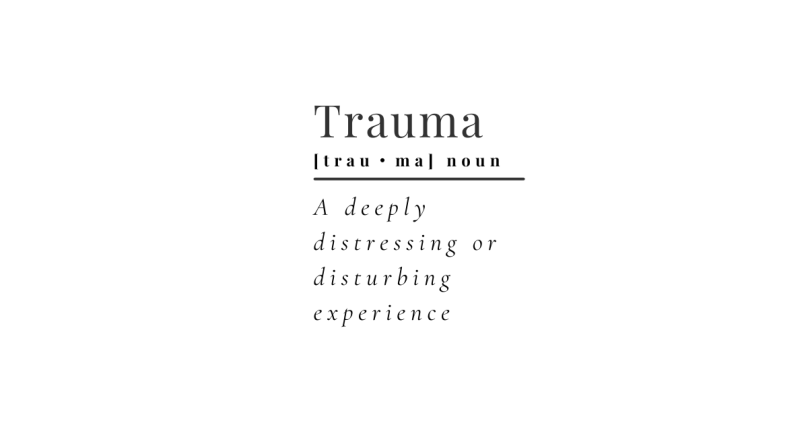
By definition, trauma is a deeply distressing or disturbing experience. Most people tend to think of trauma at the most severe level (i.e. war, rape, witnessing murder, physical or sexual abuse, etc). Of course all of those physically violent events would be severely traumatic to anyone. However, it is important to remember that experiences not involving physical violence can be severely traumatic as well.

A Common Misconception

It is all too common that we dismiss less severe traumatic events as nothing more than an uncomfortable or upsetting situation. I, myself, have been guilty of not recognizing events as “traumatic” unless they involved physical violence. Until I began seeing a psychologist in 2018 for struggles with anxiety, I did not not consider any of my life experiences to be “traumatic”. During our first session, she asked me about my childhood, my parents, my friends, and my more recent experiences in life. After discussing a couple of specific events with her, she made a statement along the lines of how traumatic this must have been due to all of the emotional distress I had described. I told her I never considered any of my life experiences as “traumatic”. Once she discussed what trauma actually is, I realized some of my experiences had actually been “traumatic”.

Trauma is Not Just the Event

This conversation with my psychologist sparked a greater interest regarding the topic of trauma. I found greater insight on Psychology Today where trauma is more clearly defined as “an emotional response to severe psychological distress following any terrible or life-threatening event”. Psychological distress is defined as “a state of emotional suffering associated with stressors and demands that are difficult to cope with in daily life”. Therefore, any event causing an extreme emotional response could be considered as trauma – even seemingly “mild” experiences. A greater emotional and physiological response typically follows with every repeated exposure of traumatic experiences – again, even mild ones. With repeated exposure, we become more hyper vigilant to events that resemble the original trauma – aka “tiggers”. We all respond to trauma differently, but those experiences – especially when exposed in childhood – will effect how we respond to future events.

The Body Keeps the Score

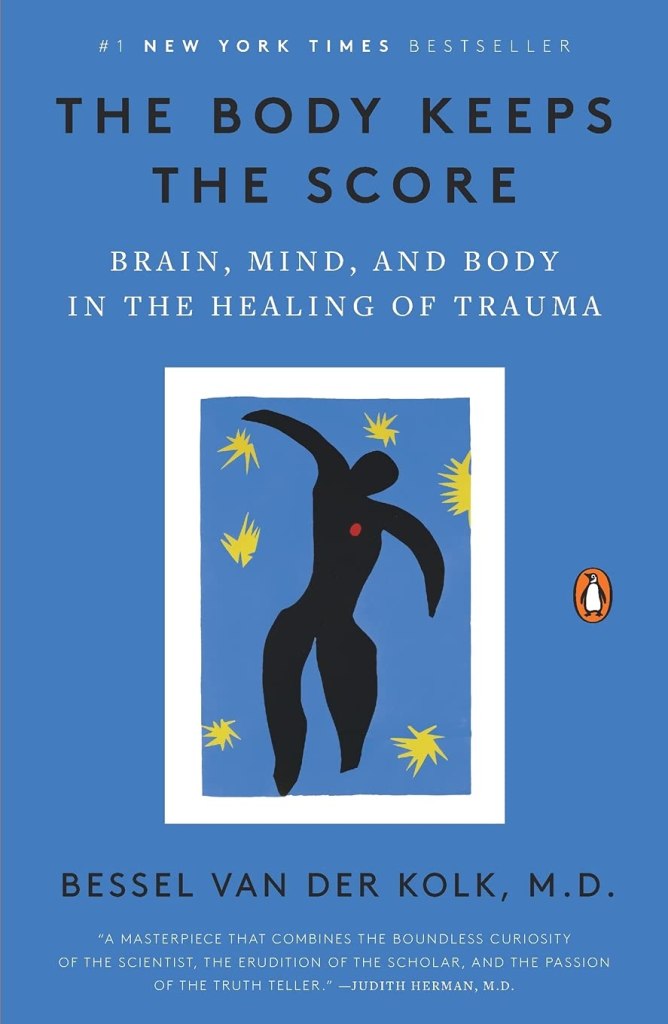
I recently began reading a book titled “The Body Keeps the Score” – this book explains how our brain, mind, and body heals from traumatic events. The author, Bessel Van der Kolk, M.D., has been highly involved in the research of trauma and his book offers great insight on how our whole body responds to trauma even long after the traumatic event occurred. His research has even shown that two people experiencing the exact same event may respond in completely different ways – both psychologically and physiologically. In various studies he conducted, the phyisologic response to triggers of the initial event, even 10+ years later, remained the same. I highly recommend this book for anyone interested in trauma – a link is provided below.

We All Have a Past

It is important to recognize and understand that we all have a past and our experiences, even those from childhood, can continue to effect our responses to various events years down the road. Even if we experience the exact same event, we may react one way while another person reacts a completely different way. We should not minimize someone else’s experience nor blame a victim (not even if a self-proclaimed victim) of any level of trauma – even if we feel we would not have been effected by that event or would not react that way to a certain situation. The fact of the matter is that we all have a past that may have “created” our current response to a “triggering” event. Further, we all deal with certain experiences that may be difficult to describe in a way that explains the true depth of our experience. Every single person deserves to feel validated by their emotions and perceptions. If a person is courageous enough to share their experience with you, please be mindful of how you respond. While you may not understand, you can still validate and support him or her.

Final Thoughts

In conclusion, I encourage everyone to become more aware of how you respond to others – adults and children as well. Be mindful that everyone reacts to events and various life situations differently – and the majority of the time, it is not because they’re “crazy” or “unstable”. Their life experiences have most likely shaped that response. While you may not understand, you don’t have to in order to be supportive and provide encouragement. More often than not, people just want to feel heard and validated.

For more information, please see the link provided here.

Book Linked Here: The Body Keeps the Score

Take Care Signature
"Toxic" People

Defining “Toxic” People

What does it mean to be a “toxic” person?

I have grown to despise this term more and more as of lately. In our world today, the word “toxic” is overused and often an excuse to avoid accountability for our own behavior. We all exhibit toxic behaviors from time to time. Expecting a person to act and behave perfectly all of the time is completely unrealistic, especially if a person is going through a difficult period in their life or under a lot of stress. We don’t always know when someone is going through a difficult period of life or in stressful situations. It is important to acknowledge that we may not have the full story so we must be willing to show grace and compassion for others when they are demonstrating toxic behaviors. Not all people are even aware of their toxicity. Some people are more focused on other’s toxicity rather than their own – but with time, many people are able to self-reflect and work towards self-improvement rather than focusing on how other people may need to improve. However, what sets a true “toxic” person apart from the average person is their consistent negative behaviors over a long period of time. True toxicity exists when a person is unwilling to acknowledge and improve their behavior. Truly toxic people expect others to constantly work on their behavior but never work on improving their own. Once you improve your weak areas, they move the goal posts and expect more and more out of you while giving nothing in return.

Another point worth mentioning is that our perception of a person’s behavior is not always accurate. For example, we may perceive a shy person as rude and unfriendly when in reality they may be afraid of being judged so they shy away from social interactions with people they don’t know very well. In addition, we must become aware of our personal “triggers” and understand that just because someone triggers us, does not mean they are a negative or toxic person. Make sure to consider the other person’s intention and your own pain before writing someone off as “toxic”.


Most Common Traits of Highly Toxic Individuals

In order to identify a highly “toxic” person, we must know what to look out for. See the list below for the most common toxic traits:

  1. Toxic people are manipulative. Period. They use anyone and everyone in their life to achieve their own selfish desires. They do not care what you want and will not consider your wants or needs. They may seem to in the beginning, but that is part of how they manipulate you. They essentially groom you to buy into their facade so they can take full advantage of you later on. Often, these individuals are skilled manipulators and have been perfecting their craft for years; therefore, it is likely you may not even realize it until much later on.
  2. Toxic people are judgmental. When you first get to know a person, pay attention to how they criticize others to their face and behind their back. Before long, they’ll be doing the same to you. Their focus will be on what you’ve done or what you didn’t do – it will never be about them. If you ever try to hold them accountable, expect an intense reaction.
  3. Toxic people take no responsibility for their own feelings. They project their feelings onto you. More simply, this means the toxic person will unconsciously take their unwanted emotions or traits they do not like about themselves and attribute them to you. They may even behave in a particular way to evoke a negative response from you so they can blame you for your reaction or response. If you question them, they will defend themselves and their perspectives forevermore. They will not take responsibility for what they have done. If they do, it will either benefit them in some way or be a set up for future manipulation.
  4. Toxic people do not apologize. Everything will always be someone else’s fault. If they do apologize, it will be a poor excuse for an apology and they will not make any effort to improve their behavior. They may even go so far as to play victim in order to gain sympathy and attention from others.
  5. Toxic people are inconsistent. They are not the same person every time you are with them. Notice how their personality shifts depending on their audience. If they have a motive or want to accomplish something from a situation, their attitude, behavior, and perspective may drastically change. They know how to turn on the charm when they want something from you.
  6. Toxic people make you prove yourself to them. This can be done in various ways and in various situations from mild to extreme. For example, they may ask you where you want to go for dinner. When you tell them where you’d like to go, they will make an excuse as to why they don’t want to go there – “I just had that last week; we can go anywhere but there” or “ugh, I hate that place” – when they go there with their friends all the time. They essentially force you to conform to their wants, needs, or desires. In the most severe circumstances, this can turn into a “divide-and-conquer” situation where the only choice is them, even if that means severing ties with other close relationships you may have.
  7. Toxic people make you defend yourself. Healthy people are interested in compromising and resolving conflict so that everyone can be satisfied. Toxic people are only interested in satisfying themselves. They do not care about your point of view or resolving an issue. They will manipulate you by being vague, playing victim, and diverting attention away from the issue. They will focus on how you’re discussing the issue – your tone, your demeanor, your words, etc. Their focus is on problems, never a solution.
  8. Toxic people are not caring, supportive, or interested in what is important to you. They will always find a way to divert the attention back to them. If bad things happen to you, something worse happened to them. If good things happen to you, something better happened to them. If you’re having a struggle in a certain area of your life, they will go on and on about how great that area of their life is OR how their situation is worse. If you have plans with them, they ditch you when a more exciting opportunity comes along. If you are talking about something you are passionate about, they change the subject. They make sure the attention is always on them. Often, they will appear uninterested during conversations where the attention is on someone else.

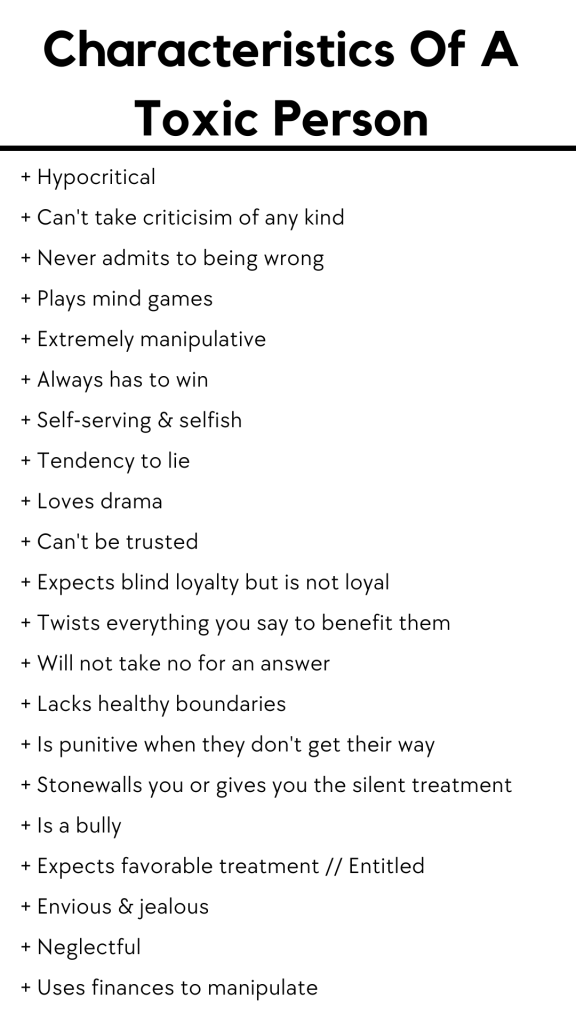
While many traits are listed above, this is certainly not all of them – these are just the most common. I saw the list below in a post on Instagram which indicates more specific qualities often seen in toxic individuals.


Characteristics Of A Toxic Person

Final Thoughts

To reiterate, we all demonstrate toxic behaviors at some point in our lives and that is okay. We are only human. When we take the time to self-reflect and make an effort to become more aware of our own toxicity, we can better ourselves and be better to those around us. Most people do not want to hurt others and will give effort to better themselves so they don’t continue to hurt people in their lives. Unfortunately, there are people in the world who refuse to take responsibility for their own actions and behaviors and they don’t care if they hurt you. Sure, they may not necessarily “want” to hurt you, but they don’t care enough to make an effort not to. These people are unhealthy to have any type of close relationship with. They will make you feel unheard, unseen, and unimportant – just so they can feel heard, seen, and important. People can always change, but highly toxic people generally do not.

In addition, a person can be “toxic” to one person, but seemingly not to another. How? Well, it is actually quite simple. Individuals that they do not appear toxic to are the people they can continue to gain an advantage from. At their very core, toxic people are skilled manipulators lacking the ability to care for or truly empathize with another person. Every person in their lives are on puppet strings and they are the puppet master. They get a thrill of being able to take advantage of other people for whatever reason it may be. They love knowing they can control other people without them even noticing. They may even be able to show “empathy” in situations, but this is usually due to their observation of other people’s behavior. They learn how to fake empathy and are able to imitate what they have seen others do. Truly toxic people will be on their best behavior around those they can gain any advantage from – no matter how big or small that advantage may be. Once they can no longer gain anything from you, they will begin to treat you badly or just forget you exist all together – because your existence no longer serves them. Beware of these people and keep distance from them. Find people who truly care about you, who will not use you to their advantage, who will uplift you, and who want to see good things happen to you. Don’t waste anymore time on those who don’t.

This article served as a guide for this post.

Take Care Signature
The Dark Triad

The Dark Triad Personalities

What is the Dark Triad?

The Dark Triad Traits

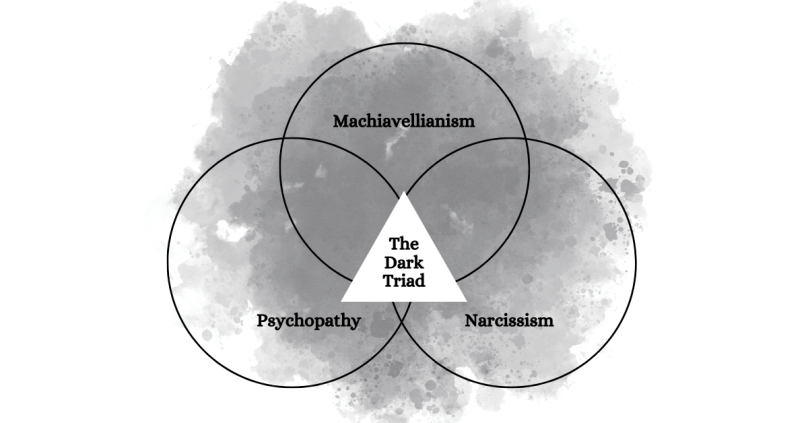
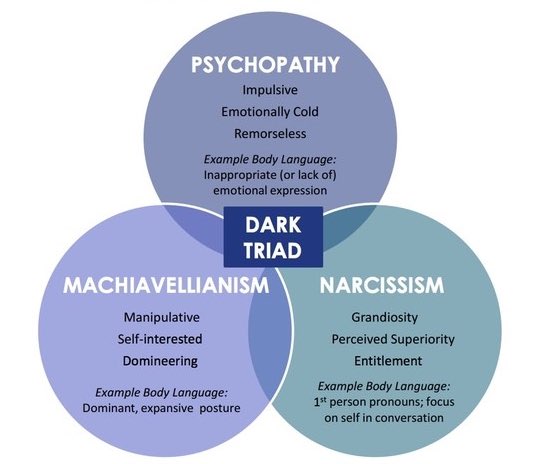
The Dark Triad, a term coined by Paulhus and Williams in 2002, typically refers to three severely negative personality traits – narcissism, Machiavellianism, and psychopathy. “Dark Triad” refers to individuals who possess these negative traits, but may not necessarily present with a diagnosis of a full-blown personality disorder.

All three of these negative personality types (further described below) are generally marked by varying degrees of aggression motivated by self-interest, lack of empathy, and skilled manipulation.


Narcissism

Narcissism is a term often used to describe someone who is generally self-centered or obsessed with their appearance. In the dictionary, this term is defined as “excessive interest in or admiration of oneself and one’s physical appearance”. However, when we are speaking of personality traits as a whole, narcissism embodies much more than that. Below is a list of narcissistic traits, as found on Medical News Today (link also provided below):

  • An insatiable appetite for the attention of others
  • Extreme feelings of jealousy
  • An expectation of special treatment
  • Exaggerating achievements, talents, and importance
  • Extreme sensitivity and a tendency to be easily hurt and to feel rejected with little provocation
  • Difficulty maintaining healthy relationships
  • Fantasizing about their own intelligence, success, power, and appearance
  • An ability to take advantage of others to achieve a goal, without regret or conscience
  • A lack empathy, or ability to understand and share the feelings of others, and a tendency to disregard others’ feelings
  • A belief that only certain people can understand their uniqueness
  • A tendency to consider themselves as skilled in romance
  • Responding to criticism with anger, humiliation, and shame
  • Seeking out praise and positive reinforcement from others
  • An expectation that others will agree with them and go along with what they want
  • Whatever they crave or yearn for must be “the best”

Click here to read more.

Most people would identify with a few of these traits at some point or another in their life. For example, I identify with “seeking out praise and positive reinforcement from others” sometimes, especially when I’m not feeling confident about something – whether that be appearance or certain skills with my job. I also identify with “responding to criticism with anger, humiliation, and shame” sometimes, especially when the criticism is unnecessarily harsh. Does that make me a narcissist? Absolutely not. Identifying with some of these traits is completely normal. We all have some narcissistic tendencies from time to time and that is okay! However, it becomes more serious when these traits are present all of the time across various contexts – especially when manipulation is involved.

Further, narcissism isn’t a one-size-fits-all category. Narcissism lies on a spectrum and comes in varying levels of severity. Oftentimes, we think of narcissists as extremely attractive or extremely wealthy men or women. However, narcissists can be found in any level of socioeconomic status, race, religion, occupation – you name it. Appearance doesn’t play a factor either. In terms of psychology, narcissism exists as mental condition called Narcissistic Personality Disorder (NPD). However, not all people with narcissistic traits have NPD. I have provided a list of signs and symptoms of NPD below, as found on Mayo Clinic’s website. I have also provided the link for further information.

Signs and symptoms of narcissistic personality disorder and the severity of symptoms vary. People with the disorder can:

  • Have an exaggerated sense of self-importance
  • Have a sense of entitlement and require constant, excessive admiration
  • Expect to be recognized as superior even without achievements that warrant it
  • Exaggerate achievements and talents
  • Be preoccupied with fantasies about success, power, brilliance, beauty or the perfect mate
  • Believe they are superior and can only associate with equally special people
  • Monopolize conversations and belittle or look down on people they perceive as inferior
  • Expect special favors and unquestioning compliance with their expectations
  • Take advantage of others to get what they want
  • Have an inability or unwillingness to recognize the needs and feelings of others
  • Be envious of others and believe others envy them
  • Behave in an arrogant or haughty manner, coming across as conceited, boastful and pretentious
  • Insist on having the best of everything — for instance, the best car or office

At the same time, people with narcissistic personality disorder have trouble handling anything they perceive as criticism, and they can:

  • Become impatient or angry when they don’t receive special treatment
  • Have significant interpersonal problems and easily feel slighted
  • React with rage or contempt and try to belittle the other person to make themselves appear superior
  • Have difficulty regulating emotions and behavior
  • Experience major problems dealing with stress and adapting to change
  • Feel depressed and moody because they fall short of perfection
  • Have secret feelings of insecurity, shame, vulnerability and humiliation

Again, if you identify with some of these traits, that does not mean you have NPD. In order to be diagnosed, you must be evaluated by a trained psychologist. It is also highly important to note that many individuals with NPD never receive a diagnosis because these persons are highly unlikely to seek out professional help due to the nature of the disorder.

Click here to read more.


Machiavellianism

Machiavellianism is not a personality disorder, but rather a set of behaviors and attitudes. This term is used to describe behavior that is deceitful, calculated, and exploitative. While narcissistic behavior is described similarly, Machiavellianism is marked by strategic planning of deception over a long period of time. Two other major distinctions include the type of deception used and their attitudes about morality.

Further, the Machiavellian is more likely to break laws. The consequences of breaking the law in question will determine if it is worth the risk to fulfill their self-interest – not because it is morally “wrong” or unethical. They do not care if their behavior goes against moral code. It means nothing to them as long as they gain whatever they are seeking. Their strategic planning of deceit is done quite purposefully in order to gain a long-term advantage.

Click here and here to read more.


Psychopathy

The term “psychopath” is used a lot in today’s society to describe someone behaving erratically or someone who seems “emotionally unstable”. In the area of psychiatry, the actual term for psychopathy is Antisocial Personality Disorder (ASPD) – which describes an individual who displays patterns of manipulation and violation of others. Don’t let the word “antisocial” fool you. When used in this context, it is a descriptor term for someone who goes against the common rules of society. Below is a list of signs found on Heathline (see link provided for more information):

  • socially irresponsible behavior
  • disregarding or violating the rights of others
  • inability to distinguish between right and wrong
  • difficulty with showing remorse or empathy
  • tendency to lie often
  • manipulating and hurting others
  • recurring problems with the law 
  • general disregard towards safety and responsibility

Click here to read more.


Psychopath vs. Sociopath

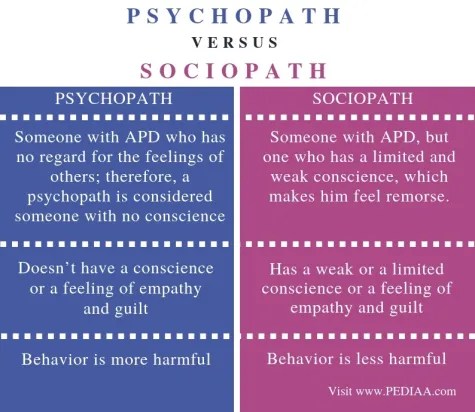
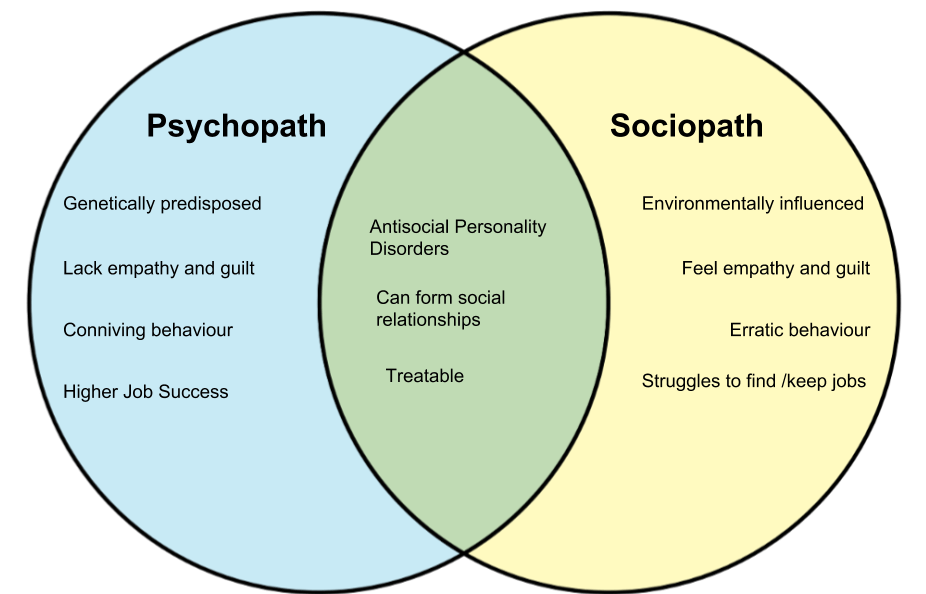
Psychopath and sociopath are similar terms, but have different meanings. See the charts provided below, as they discuss the primary differences between the two terms.

Psychopath versus Sociopath Chart

Psychopath versus Sociopath Venn Diagram

Images obtained by pediaa.com (top) and relatablethoughts.wordpress.com (bottom).


Final Thoughts

In summary, individuals possessing many of these traits are incredibly mentally and emotionally unhealthy to be around. However, it is rather tricky to pinpoint these behaviors until you have spent a lot of time with the Dark Triad individual. Often, the behaviors begin subtly and go unnoticed until you are fully invested with the individual. Although I believe we should give a person the benefit of the doubt in many circumstances, we should never completely ignore red flags, no matter how small they may seem. It could save you a lot of time and heartache. I will discuss red flags and the typical “relationship” stages of being involved with an individual with these traits in my next couple of posts.

Until then,

Take Care Signature